Showing posts with label a chorus line. Show all posts

Sunday, April 26, 2015

Curtain Up: Top 10 Overtures

Let's talk about one of the most crucial parts of a musical: The Overture. The overture sets the tone for the show. It features samples of songs that will be heard throughout the show and sets the mood for the next 2½ hours. It is a piece of music that basically says to the audience, “Hi there. I’d like to introduce you to this musical. I really think you’ll get along.” Then you say, “Holy Hell, what did I just hear!? I am so friggin’ PUMPED for this musical to start!!!!”

There is nothing like a super kickass overture. A great one feels like the opening of a Queen concert, the kickoff at the Superbowl, and a screening of Oprah’s “My Favorite Things”. Combined. I have scoured the annals of Broadway for overtures and opening numbers that simply peel the paint off the walls. I present to you (in no particular order) the Top 10 Broadway Overtures and Opening Numbers Of All Time.

1. "Prologue" - Ragtime
Ragtime tells several intertwining stories of the African Americans of Harlem, the upper-class suburbanites of New Rochelle, and the European Immigrants populating America at the start of the 20th century. The opening number portrays the three groups clashing (musically and physically) with each other as they express their respective ambitions and creeds at the start of a new century. The big “company front” at the end gives me chills every time I hear it. 


2. Phantom of the Opera
In all fairness, the overture of POTO only samples the titular song. But boy, is it a doozy! Just the opening six notes is like the clouds parting and Zeus popping out of his Olympus fortress with a Les Paul going, “Hey, mortals! Check out this tasty riff!” *metaphorically throwing panties on stage*


3. Jesus Christ Superstar
Yup, Andrew Lloyd Webber gets double love in this entry. Superstar puts the “rock” in “rock opera”. This overture sets the haunting mood from the very first note. But then the wicked horn, drums, and guitar action kicks in and I just wanna grab a lighter and wave it in the sky while head banging like Wayne’s World. 


4. “Tradition” – Fiddler On The Roof
This overture basically says “Here’s this detailed layout of our community’s simplistic-yet-moribund way of life. Stay tuned and see how it all falls apart! …plus we’re all Jewish! Hope that doesn’t have any repercussions in Tzarist Russia!” And you gotta love the ridiculously lively, klezmer-inspired score going on here! I triple dog dare you to breathe when the bottle dancers move to the ground.


5. “I Hope I Get It” – A Chorus Line
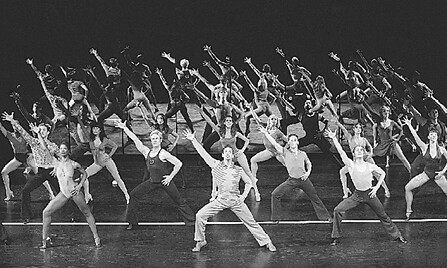
I wrote about this show last year, so I’m just gonna reiterate my crazy love for this musical here: From the first “Five, six, seven, eight…” when the dancers turn and face the audience for the first time, you can hear the underlying stress and anxiety among the flying arms and legs in the music and choreography. This reflects the characters’ desperation to land this job because it means one more opportunity to dance; they want this with all their heart and soul. This opening number hits the ground running with both guns blazing while yelling “ENERGY” in your face. ‘Nuff said.


6. “The Ballad of Sweeney Todd” – Sweeney Todd
When I first watched the video recording of this show at the tender age of 9, I ran out of the room in fear at one point. Listening to the album alone gave me the creeps (mostly because of that friggin’ factory whistle). But super-creepy subject matter aside, this opening number is, in short, bad-ass. What other musical starts with the lead emerging from an oven and an ensemble calling us to the campfire for a gourmet scary story? There is not a single thing about this number that doesn't kick copious amounts of ass.


7. Candide
I’ve never actually seen Candide, nor do I know very much about it (except that it contains the greatest Broadway coloratura aria EVER). But this overture is arguably the liveliest, peppiest classical-fusion piece Leonard Benstein’s ever gifted to Broadway.  It doesn’t even give the audience a moment to breathe, so I can only imagine how the members of the orchestra handle it!


8. Gypsy
Two words: Trumpet. Solo. 


9. “Circle of Life” – The Lion King
This opening number is definitely more of a visual feast than an audio one, but Sweet Baby Jesus, it’s amazing! It almost makes the rest of the show a bit of a low because there are few points in the show higher and bigger than the opening. This number puts every Superbowl halftime show to shame ...and they typically do it twice a day.


10. West Side Story
Before a single note is played, Mr. Bernstein gets our attention with the show’s trademark short-long-short whistle (which I personally prefer as a gang signal over oddly-and-most-likely-dangerously-placed graffiti defacing public property). Then he unloads this loud, wild plethora of food for the ears with urgent tones and south of the border flavor. The clashes and interactions between the rival Jets and Sharks, the star-crossed lovers, and the law are represented in this pumping, beautiful traffic jam of an overture. *Fun fact: West Side Story didn’t do well its first time around on Broadway. Audiences weren’t quite ready for the “gritty, dark” musical genre. It lost the Best Musical Tony to Music Man that year.*


Friday, May 30, 2014

Won't Forget, Can't Regret What "A Chorus Line" Did For Me

Lermontov: Why do you want to dance?
Vicky: Why do you want to live?
Lermontov: Well, I don't know exactly why, but... I must.
Vicky: That's my answer too.

― The Red Shoes

I’m going to start today’s post with the happy announcement that I just got engaged to a Nice Jewish Boy and am friggin’ ecstatic.

Ok, now that that’s done with, on to the Broadway love.  I’ve seen about 5 or 6 shows in the last 3 weeks, so I’m a little backlogged with Broadway love!

The Players Club of Swarthmore recently closed their wildly successful production of A Chorus Line and I had the honor of sitting in the audience twice for this significant musical piece. I was familiar with the music and knew it was about dancers and their stories, but I had never seen it. I am here to say that even if you’d never heard about A Chorus Line, never saw A Chorus Line, or didn't give a fuck about A Chorus Line,” you should see A Chorus Line at some point in your life (but not the film version, I hear it sucks) because, as I found out, it touches on material that transcends mere dancing and applies to us all in some form.

First of all, let’s talk about the dancing. From the first “five, six, seven, eight”, we are thrust into a world where dance is EVERYTHING. From the first note when the dancers turn and face the audience for the first time, you can hear the underlying stress and anxiety among the flying arms and legs in the music and choreography. This reflects the characters’ desperation to land this job because it means one more opportunity to dance; they want this with all their heart and soul.


A Chorus Line was originally a workshop created from a series of taped sessions with several dancers, nicknamed “gypsies.” These sessions consisted of the “gypsies” simply talking, disclosing how/why they became dancers and stories of their past. Director/choreographer, Michael Bennett, soon became involved in the workshop and ran with the concept. A Chorus Line is indeed about dancers (and they do a LOT of dancing). But it’s not your standard “a-bunch-of-dancers-put-on-a-show-to-save-the-theatre” fluff. It sheds a glaring light on a group of people who otherwise normally must make it a priority to be the frame, the wallpaper, the stage filler, the background, and the mechanically-functioning human props that showcase the “stars.” It highlights the diverse, colorful personalities of those who throw themselves at an unforgiving, merciless industry, all for just one more opportunity to dance on stage.

The show introduces us to a small handful of hopeful dancers vying for a spot in a Broadway chorus line. They are taken aback and apprehensive when casting director, Zach, asks them to tell him more about themselves than what is already on their resumés. In order to get this job, they must put not just their skills, but themselves on the line. One by one, they begin to divulge and share personal tales of their education, adolescence, home life, sexual experiences, and what inspired them to become dancers.

Cassie, once a featured dancer (and former lover of Zach’s), has returned from a less-than-stellar stint in California to pursue a role in Zach’s chorus. He tells her that she’s too good for the chorus and shouldn't be at this audition. But she doesn’t want stardom. She doesn’t want a career of dead-end movie roles or commercials or to open a studio and teach; she merely wants to dance. She is willing to "come home" to the chorus so she can do what she does best.  She puts herself on the line (Zach’s line), pleads with him to give her this job, and dances for her fracking life.

When one dancer suffers a sobering injury during auditions, Zach asks the others what they would do and how they would feel if they couldn’t dance anymore. No one has a solid answer as they grapple with the hard reality that they won’t be able to dance forever. They discuss the hardships of being in show business – aging, injuries, bills, the decline of dance-heavy shows, the lack of jobs and job security – and life after dancing. They each speculate what they would/could do for a living and resolve that no matter what happens, they will do what they love as long as they possibly can.


The finale, "One”, begins with an individual bow for each of the nineteen characters, their hodgepodge rehearsal clothes replaced by identical spangled gold costumes. As each dancer joins the group, it is suddenly difficult to distinguish one form the other. Each character who was an individual to the audience is now an anonymous member of an ensemble. The dancers form the iconic kick-line that continues as the curtain descends. Michael Bennett said, “… I want people in the audience to go to other shows and think about what's really gone into making that chorus . . . It fades with them kicking. That's it. That's the end of the show. There are no bows. I don't believe in bows, just the fade out. That's what a dancer's life is.”


Everyone can find at least one song or character they identify with in A Chorus Line. Be it having a less-than-stellar home life; coming to terms with sexuality; frustration from having to beg, plead, lie, steal, cheat, and fight to pursue your passion; overcoming things out of your control (like being 4’10), and changing the things you can control (like your tits and ass). A Chorus Line has an affecting, universal theme that anyone can relate to. In the Playbill listings, the show was dedicated "to anyone who has ever danced in a chorus or marched in step . . . anywhere." A Chorus Line reminds us that everyone has a face, a name, and a voice. Everyone is special.