Showing posts with label sondheim. Show all posts

Sunday, April 26, 2015

Curtain Up: Top 10 Overtures

Let's talk about one of the most crucial parts of a musical: The Overture. The overture sets the tone for the show. It features samples of songs that will be heard throughout the show and sets the mood for the next 2½ hours. It is a piece of music that basically says to the audience, “Hi there. I’d like to introduce you to this musical. I really think you’ll get along.” Then you say, “Holy Hell, what did I just hear!? I am so friggin’ PUMPED for this musical to start!!!!”

There is nothing like a super kickass overture. A great one feels like the opening of a Queen concert, the kickoff at the Superbowl, and a screening of Oprah’s “My Favorite Things”. Combined. I have scoured the annals of Broadway for overtures and opening numbers that simply peel the paint off the walls. I present to you (in no particular order) the Top 10 Broadway Overtures and Opening Numbers Of All Time.

1. "Prologue" - Ragtime
Ragtime tells several intertwining stories of the African Americans of Harlem, the upper-class suburbanites of New Rochelle, and the European Immigrants populating America at the start of the 20th century. The opening number portrays the three groups clashing (musically and physically) with each other as they express their respective ambitions and creeds at the start of a new century. The big “company front” at the end gives me chills every time I hear it. 


2. Phantom of the Opera
In all fairness, the overture of POTO only samples the titular song. But boy, is it a doozy! Just the opening six notes is like the clouds parting and Zeus popping out of his Olympus fortress with a Les Paul going, “Hey, mortals! Check out this tasty riff!” *metaphorically throwing panties on stage*


3. Jesus Christ Superstar
Yup, Andrew Lloyd Webber gets double love in this entry. Superstar puts the “rock” in “rock opera”. This overture sets the haunting mood from the very first note. But then the wicked horn, drums, and guitar action kicks in and I just wanna grab a lighter and wave it in the sky while head banging like Wayne’s World. 


4. “Tradition” – Fiddler On The Roof
This overture basically says “Here’s this detailed layout of our community’s simplistic-yet-moribund way of life. Stay tuned and see how it all falls apart! …plus we’re all Jewish! Hope that doesn’t have any repercussions in Tzarist Russia!” And you gotta love the ridiculously lively, klezmer-inspired score going on here! I triple dog dare you to breathe when the bottle dancers move to the ground.


5. “I Hope I Get It” – A Chorus Line
I wrote about this show last year, so I’m just gonna reiterate my crazy love for this musical here: From the first “Five, six, seven, eight…” when the dancers turn and face the audience for the first time, you can hear the underlying stress and anxiety among the flying arms and legs in the music and choreography. This reflects the characters’ desperation to land this job because it means one more opportunity to dance; they want this with all their heart and soul. This opening number hits the ground running with both guns blazing while yelling “ENERGY” in your face. ‘Nuff said.


6. “The Ballad of Sweeney Todd” – Sweeney Todd
When I first watched the video recording of this show at the tender age of 9, I ran out of the room in fear at one point. Listening to the album alone gave me the creeps (mostly because of that friggin’ factory whistle). But super-creepy subject matter aside, this opening number is, in short, bad-ass. What other musical starts with the lead emerging from an oven and an ensemble calling us to the campfire for a gourmet scary story? There is not a single thing about this number that doesn't kick copious amounts of ass.


7. Candide
I’ve never actually seen Candide, nor do I know very much about it (except that it contains the greatest Broadway coloratura aria EVER). But this overture is arguably the liveliest, peppiest classical-fusion piece Leonard Benstein’s ever gifted to Broadway.  It doesn’t even give the audience a moment to breathe, so I can only imagine how the members of the orchestra handle it!


8. Gypsy
Two words: Trumpet. Solo. 


9. “Circle of Life” – The Lion King
This opening number is definitely more of a visual feast than an audio one, but Sweet Baby Jesus, it’s amazing! It almost makes the rest of the show a bit of a low because there are few points in the show higher and bigger than the opening. This number puts every Superbowl halftime show to shame ...and they typically do it twice a day.


10. West Side Story
Before a single note is played, Mr. Bernstein gets our attention with the show’s trademark short-long-short whistle (which I personally prefer as a gang signal over oddly-and-most-likely-dangerously-placed graffiti defacing public property). Then he unloads this loud, wild plethora of food for the ears with urgent tones and south of the border flavor. The clashes and interactions between the rival Jets and Sharks, the star-crossed lovers, and the law are represented in this pumping, beautiful traffic jam of an overture. *Fun fact: West Side Story didn’t do well its first time around on Broadway. Audiences weren’t quite ready for the “gritty, dark” musical genre. It lost the Best Musical Tony to Music Man that year.*


Sunday, December 28, 2014

Into The Woods, You Go Again: A Motion Picture Review

Well, boys and girls, the highly-anticipated motion picture version of Into the Woods has FINALLY been released. Our original plan was to see The Interview on Christmas Day and wait until New Years Day to see Into the Woods, but some high-n'-mighty hackers with their eyes on terrorism changed that up a bit. *Side note: I did end up seeing The Interview on December 26. Up yours, you angry little Asian potato-bodied manbaby! Totally not worth the fuss. It's a Seth Rogen/James Franco movie for God's sake! Not some witty, biting political commentary. There's been more offensive shit on Family Guy!) If anything, it made more fun of 'Murica than North Korea.

I had my firm doubts about this movie. I was pretty nervous after 2012's half-epic-masterpiece-half-Russell-Crowe-shitstorm, Les Miserables. I thought Meryl Streep was going to just barely get through the songs like in Mamma Mia!. I thought Johnny Depp was going to pull his drunken, stoic Sweeney Todd character back out for his turn as The Wolf. I thought that Anna Kendrick would stand around like Kristen Stewart in Twilight. I feared that Hollywood might take what is arguably Stephen Sondheim's most beloved, stirring, well-known pieces and cram it into another heavy-handed, CGI-stuffed mass of auto-tuned drek with questionable casting and a "Disneyfied" sugar coating (or, more recently, a dark, gritty, sexy turn on shit we've already seen). Thankfully, my fears were unfounded, as the movie turned out to be (in my humble opinion) a devoted, carefully-handled film that stood on its own and maintained the profound and universal themes present in the stage production.

Into The Woods
Music & Lyrics: Stephen Sondheim 
Book: James Lapine
Based On: Grimm's Fairytales & Bruno Bettelheim's The Uses of Enchantment
Broadway Debut: 1987
Tony Nominations/Wins: 10/3 (Phantom of the Opera swept that year)


The Story:
The musical intertwines the characters and plots of several Brothers Grimm fairy tales - Little Red Riding Hood, Jack & the Beanstalk, Cinderella, Rapunzel, etc. - and follows them (literally) into the woods to explore the consequences of the characters' wishes and quests. The musical is tied together by an original story involving a childless baker and his wife and their quest to begin a family, their interaction with a neighboring witch who has placed a curse on them, and their interaction with other storybook characters during their journey. The second act examines what happens after "happily ever after" and reminds us that wishes, paths, and journeys change with time and experience.

The Themes:
The tagline for this movie is "Be careful what you wish for." Though it is an integral part of the musical and probably tested best for family viewers, I think that Disney spent way too much time on focusing on the "Be careful what you wish for" theme. Wishes change as we change. We grow and want different things as we encounter new things in life. We learn from our mistakes and the mistakes of others. There are no simple, happy endings because we're human and we're never finished, even if the dream is achieved or the curse is lifted. There is so much meaty subject matter that you can't focus on just one theme throughout. The show indeed covers wish fulfillment and its consequences, but it also examines growing up, parents and children, accepting responsibility, morality, and dealing with adversity. As we grow, we find that our parents don't have all the answers and are not always right. They make decisions whose consequences sometimes fall on their children. They may neglect or overprotect their children out of love, but it may result in an accidentally f*cked up child.
Witch: "What's the matter?"
Rapunzel: "Oh... nothing. You just locked me in a tower without company for fourteen years, then blinded my prince and banished me to a desert where I had little to eat and again no company...and then bore twins! Because of the way you treated me, I'll never, never be happy!"
Witch: "I was just trying to be a good mother."
We often lose sight of right and wrong when emotion intervenes. Should we surrender a young boy to a vengeful giant because she threatens violence on the rest of the kingdom (omigod! Unintentional tie-in with The Interview and the cyber-terrorists!) Should we curse those who have wronged us because it will make us feel better? Should we abandon what we wished for when it turns out differently than we expected? Our choices and actions have an effect on others. It's wise to monitor our children as well as ourselves in an effort to be better people for each other. "Careful the things you say, children will listen. Careful the things you do, children will see and learn..."

My (Small) Issues:
I'm not gonna lie. I'm judgmental. I'm a backseat critic and I don't care who knows it! I had a few issues with some factors in the film, but nothing of a "WHY THE **** DID YOU CAST RUSSELL CROWE?!?!" magnitude.

Cinderella:
Actress: I think Anna Kendrick is a very pretty, sweet, nice young lady with a lovely, pleasant singing voice and she did a fine job in the movie (I also look forward to Pitch Perfect 2). I just tdon't know if the was the absolute best choice for that role out of all the A-listers who can carry a tune. But then again, since they often flat-out refuse to cast Broadway talent, maybe she was the best person for the job...
Wardrobe: 
a) The gown is lovely. But you don't need to run down the palace steps with your dress hiked up to your thighs. I get that you want to showcase your shoes. The shoes are lovely too. But again, we can see them without you hiking your dress up to your thighs. Show some modesty, for God's sake! You're a demure, young waif in a stunning gown, not Miley Cyrus at some awards show.
b) I think this falls squarely on the shoulders of the hair/makeup/costuming person: Cinderella's ponytail. Who the hell wears a ponytail to a royal ball?! You've got the dress, the shoes, the makeup...  You can't get that gussied up and leave the hair a hot mess. You just can't.
Even the Baker's Wife is sporting an updo! C'mon!!!

The Wolf's Outfit:
I can't get over how pleasantly surprised (and oddly turned on) I was by Johnny Depp's performance. I don't know why I assumed he'd play it like every character he portrays in any Tim Burton movie (weird, strung out, brooding, under the influence of some powerful uppers or downers). But boy, did he prove me wrong! He was deliciously lecherous, sleazy, and just plain horny! Now my only problem - nay, I actually loved the zoot suit - is the time period of his wolf costume. Everyone else was slumming around in an ambiguous time period of corsets and doublets and capes and leather pants. And here comes Johnny Depp slinking around like a furry Tex Avery cartoon. Again, don't get me wrong, I love it! And it's a heck of a lot more modest than the original Wolf costume.


The Lack of Broadway Veteran Cameos: 
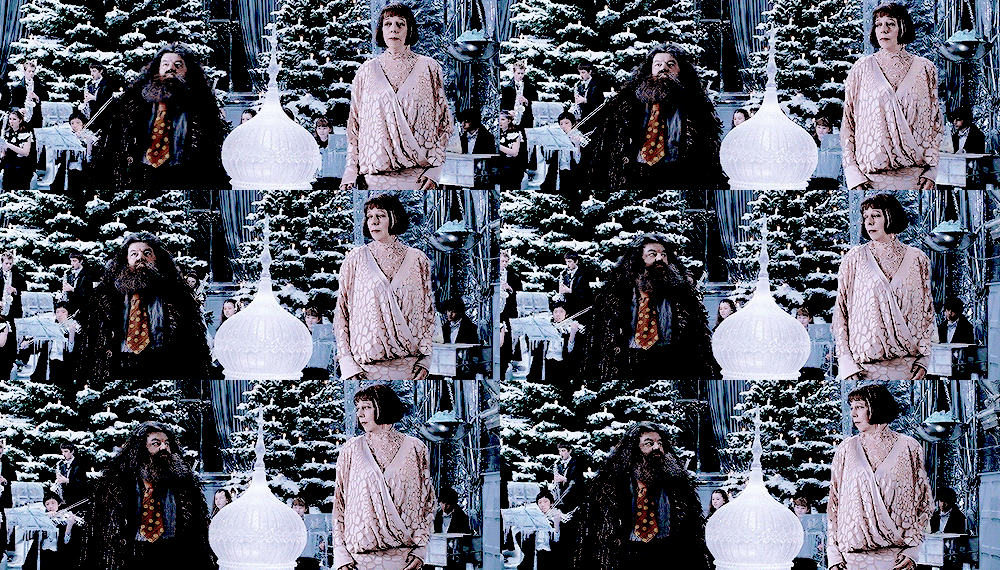
Chita Rivera in Chicago. Colm Wilkinson & Frances Ruffelle in Les Miz. Andrea McArdle in the made-for-TV Annie. Carol Burnett in the made-for-TV Once Upon A Mattress. Where are the Broadway veteran cameos?!?!  There are a ton of little bit parts they could have thrown people into! Instead we've got Shakespeare Theatre Company alumni! That's great, but what do the musical theatre snobs get out of that? Nuthin'! We get one link to Harry Potter and Tammy Blanchard! Unacceptable! Here's my Dream Cameo Cast for you right here:
Cinderella's Mother: Kelli O'Hara
Giantess: Patti Lupone
Rapunzel's Prince: Aaron Tveit
Baker's Father: Norbert Leo Butz
Lucinda & Florinda: Sierra Boggess or Laura Osnes (I guess Tammy can stay)
Red Riding Hood's Granny: Bernadette Peters (only because Elaine Stritch is dead)
Steward: Christian Borle or Jason Alexander

Jack's Mother:
No real complaints here. I just thought she was kinda mean. I think 4 slaps upside Jack's head was about 3 too many. Also, I get that they felt the need to make her death less "bloody" than in the show, but they should have made it a tad more obvious that she was supposed to die after the scene ended. If I hadn't ever seen it, I would have thought she was just out of breath lying next to a log. Help me help you, Tom Hooper...

Cut Scenes/Songs: Most movies are 2½ hours now anyway. This movie clocked in at 2 hours & 4 minutes. I didn't think it was necessary to cut a certain character's death and the song "No More." I'm not giving the death away; you'll just have to watch the original on Netflix! But seriously, they could have had the scene be a minute and a half and we'd all have closure instead of them just inexplicably dropping off the face of the earth. I mean, they weren't TERRIBLY missed scenes in the movie, but "No More" is such a pivotal song! The more I think about it, the more upset I am that it was taken out. The baker's Father explains not only that perfect fairy tale endings don't exist in reality, but also that running away from life's curveballs and losses only make you hurt more. It's quite a disservice to the climax to take out the song/dialogue that shows how vital is is to endure and not give up. I know it's hard to keep every single song of the original production in the movie version, but the thing about Sondheim's work is that every song is simply essential to the continuation of the story or exposition of the character's identity. There is no point in a Sondheim show where the characters just "park and bark" for filler. When the movie was over, my fiancé turned to me and pointed out the exact moment where "No More" should have been and mentioned that he felt something was missing from that scene. Even someone who had no prior exposure whatsoever to Into The Woods could tell when Sondheim's presence was removed. Powerful shit, my friends. Powerful shit!


So there you have it folks! I give this highly ambitious and enjoyable film an A- (B+ if I stew over "No More" much longer). There's a good chance I'll be seeing it again on New Years Day, so come on along and join me!


PS - Did anybody else catch the 3 seconds of A Little Night Music waltz score during the ball scene??? I may or may not have geeked out like a really excited Muppet...

Saturday, June 28, 2014

Follies: Live. Laugh. Love. Then Move On For Pete's Sake!

Have you ever experienced a show/cast recording (even movie) that simply got under your skin? A show that was inexplicably mesmerizing, not necessarily because you loved or hated it; and you just had to go back and listen to the piece again and again to try and fully grasp what you had just seen/heard? Back in 2011, I had such an experience that still lingers on my iPod today: Sondheim’s flawed-yet-misunderstood Follies


Follies
Music & Lyrics: Stephen Sondheim
Book: James Goldman
Broadway Debut: April 4, 1971
Tony Nominations/Wins: 11/7


The Synopsis:
Follies concerns a reunion in a crumbling, soon-to-be-demolished theatre, of the past performers of the "Weismann's Follies," that played in that theatre between the World Wars. It focuses on two couples, Buddy & Sally and Ben & Phyllis, who are attending the reunion. Sally and Phyllis were showgirls in the Follies, and Buddy and Ben their adoring Stage-door Johnnies. Both couples are deeply unhappy with their marriages. Buddy messes around while on business trips; Sally is still as much in love unhealthily obsessed with Ben as she was years ago; and Ben is so self-absorbed that Phyllis has become bitter and emotionally abandoned. The couples, along with several of the former showgirls performing their old numbers, are frequently accompanied (and/or haunted) by the ghosts of their younger selves. They endure an evening of tearing open old wounds, delusions, and self-deceptions, climaxing in a devastating realization of the “follies” of their youth.


The History Lesson:
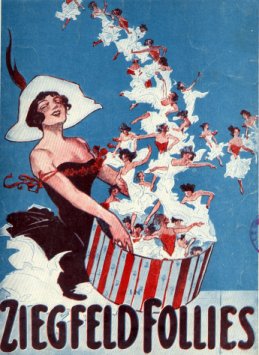
Though my fiancé is relatively “historically informed,” I don’t know why I automatically assumed that he – let alone anyone born after WWII – knew about the Ziegfeld Follies (the basis for the musical’s “Weismann Follies”).  The Ziegfeld Follies were a series of elaborate theatrical productions on Broadway in New York City from 1907 through 1931. Florenz Ziegfeld’s extravaganza was a successful marriage of just-enough naughty sex appeal and grandiose spectacle.  Colossal, elaborate, designer sets framed incredibly beautiful girls in scant, sparkly costumes and ornate headpieces.  The Follies were also the birthplace of the “variety show” and “Vaudeville” as we know it today (well, as anyone born before WWII knew it). Performers of all flavors gathered on one stage to showcase their acts to the masses.

The Ziegfeld Follies were most well-known for the famed bevy of stunning, strutting chorus girls; the trademark “Ziegfeld girls.” A bit of a hornball, Ziegfeld often personally selected the Follies Girls himself.  He wanted to glamourize and glorify the All-American Girl. On top of the requirement of being strikingly gorgeous, Ziegfeld Girls had to possess All-American wholesomeness and sex kitten allure, simultaneously. These girls reached demigoddes status among the nation’s young men.  They were often pursued and propositioned by the most wealthy and prominent men of the day.

While trying to explain this now-dead-and-buried art form to my man, I apparently got kind of excited talking about it. He asked why I spoke with such passion and appetite for such a bygone era of history and entertainment.  I guess I view the Ziegfeld Follies as something that represents a more wholesome and innocent time, culturally and aesthetically. Entertainment wasn’t as half-assed or soulless as it is now. The tried-and-true, beaten-to-death formulas we know by heart now were brand new and exciting. Sometimes, there was no formula at all, but just a collage of varied, unrelated acts, showing what they can do. Sure there was mindless shock value and sexuality back then too, but it was all live, un-Photoshopped, and real-time.  Performances were grand and “special effects” were actually special. Ziegfeld Girls weren’t just pieces of meat; they were appealing, charming, desirable pieces of meat you’d love to take home to the folks.


The Analysis:

I saw this show with my father and fiancé (then boyfriend). Both men either did or almost fell asleep at one point and avowed they did not care for the show. I will admit it was not the easiest show to get through, especially after walking around NYC all day and still being so “up” after a fantastic production of Godspell that afternoon. In all fairness, about 90% of the show’s setting resembled a cobwebby, tired, decrepit theatre; the majority of the dialogue was painfully slow; the subject matter was a real downer; and the lady seated next to us had extreme B.O. and was breathing loudly through her trache ring the whole time.  Like most Sondheim pieces, this show doesn’t pull its punches. It throws so much story and interaction and emotion at you, it’s almost impossible to digest it all in one sitting. However, I’ve got that weird lure towards offbeat characters. The characters in Follies may have had depressing stories and questionable morals, but I still found their lives and interactions and ultimate disappointments interesting to watch.

My dad found the show and characters to be tired and unenergetic with few redeeming qualities. But I saw the setting as an intentional anti-energy that meant to suck the life out of the room, because that’s how these characters feel. They’re trapped in the tattered remains of a once-glorified time and place and can only look back at their lingering ghosts. They used to be youthful and idealistic and in love, but time and reality have erased those “follies” from their lives, leaving them sad and jaded. The characters try desperately to regain their youth through re-creations of their past performances, but it’s just not the same. They can revisit the theatre, they can dance the same dances, and sing the same songs, but it only reinforces the fact that they're hollow, regretful shadows of what they once were and they can’t go back.


My brother likes to believe that his high school years were his magical, golden time and he’ll never be that happy again. My fiancé often responds to his wallowing reflections with the sage retort, “Look, don’t stare.” That is the issue with the four leads in Follies. They look longingly at their past with rose-colored glasses and are stuck in the belief that the present can’t ever be as satisfying as the past was. It must be tough spending your every waking moment, literally unable to move on from a time in your life that is long gone. 

I think that Follies is, at its core, a cautionary tale about realizing the importance of learning and growing from your past/youth instead of trying to remain there. If you compare the rest of your life to a time you've spent years glorifying in your brain, you set yourself up for disappointment.

Look, don't stare.

"If you are depressed, you are living in the past.If you are anxious, you are living in the future.If you are at peace, you are living in the present."
- Lao Tzu

Thursday, January 23, 2014

"Being Alive" and Other Reasons Why Single Life Apparently Sucks...


Greetings, Pals n’ Gals! I am once again swinging the spectrum of musical conversation back to the legendary Stephen Sondheim (I tend to do that). DISCLAIMER: There is a very good chance that every other blog entry I post (or so) will typically have something to do with the Great Stephen.  Furthermore, it has been brought to my attention that I may or may not get a little dramatic/overly poetic when discussing Sondheim’s work. For that, I make no apologies. So if you don’t like it, please visit the Complaints Department.
Lately, while observing the relationships of my married/coupled friends and family (as well as my own), a certain song has been incessantly creeping under my skin and burrowing in my brain. A song that makes me examine the ins and outs, pros and cons, simple and severe, ups and downs of a committed, full-time partnership. I am talking of none other than “Being Alive” from Company.


Company
Music & Lyrics: Stephen Sondheim

Book: George Furth

Broadway Debut: 1970

Tony Nominations-Wins: 14-6


The Show
Company revolves around 35 year-old bachelor, Bobby, and his relationships with his friends (five eccentric, married couples) and casual girlfriends. Originally titled Threes, the show is a concept musical, composed of short, non-linear vignettes, all linked by Bobby's 35th birthday celebration. He surveys from the sidelines as each of the married couples grapple with their respective issues: vices, divorce (sort of), neuroticism, infidelity, weed, and all the little things. The musical examines marriage/relationships and the reasons people come together, divorce, and stay together. With his friends acting as a less-than-attractive model for a committed relationship, Robert hopes for nothing more than an easy, no-strings-attached affair. 

The Song

The song starts with Robert exasperatedly asking, “What do you get?” He observes the pitfalls of being married through his friends and fails to grasp what compels people to allow such frustration and turmoil in their lives.  Robert first points out that in a marriage, there is ALWAYS someone there, sitting in your chair or ruining your sleep.  But then he digs deeper and finds that there’s much more to it. He sees that a relationship means someone not just being in your life, but being a key part of your life. Encouraged by his assorted married friends, he finally realizes the fulfilling and life-affirming rewards of being with somebody and wants that kind of intimacy.  “Someone” turns to “Somebody” as he proclaims that he wants to be part of something that indeed defines being alive.

“Being Alive” reflects the angst and demanding effort as well as the gains and gratification that come from being in an emotionally-intimate relationship. At first glance, nay, most glances, relationships are complicated, messy, and scary. But Robert realizes that there’s more to marriage than just being married. It’s something you work at every day. You fight and argue and cry and lose sleep and stress. Yet despite all its hardships, there is so much to win. You get to have a partner and be a partner.  A relationship is a two-way street, where neither party has all the answers, let alone the right ones.  But you get to search for them together. You bring out the best in each other and thrive together.  That sounds pretty gratifying to me.
The Legacy
Growing up, I never had a serious boyfriend (give or take a two-week We-Held-Hands-Once-So-We’re-Going-Out fling). I didn’t really feel like acquiring one either (hence the apparent lesbian rumors that circulated around my high school… without my knowledge until after I graduated. Sad panda). I’d be surrounded by friends and classmates in “relationships” and think is THIS love or intimacy? This just looks like lust and convenience and cheap jewelry.
I guess I can blame Stephen Sondheim for my early-onset cynicism.  With Company, he assured me (at the tender age of 9) that there was more to life than making out and sex and passive-aggressive manipulation with flavor-of-the-week boyfriends that my peers were accustomed to at the time. I figured if Robert didn’t have his shit figured out at 35, what the hell did teenagers know? ....Not that we ever have everything figured out. We just get better at faking it so we don’t have a meltdown at work (though I’ve been tempted!).
Sondheim has expressed displeasure in concluding the show with this song (seriously, Stephen. What is wrong with you!?), as he deems it a “cop-out.”  He had initially written two other songs to conclude Company before settling on “Being Alive;” both more jaded and sardonic versions of Robert’s ultimate revelations: “Multitudes of Amys” (sung here by the DELICIOUS Aaron Lazar!) and "Happily Ever After" (which eventually turned into "Being Alive" with a slightly more optimistic ending). I personally can’t imagine a song fitting the end of Company better than “Being Alive;” but then again, I’m not a musical genius, just an awestruck spectator. 
So much love up in here, it's disgusting...