Showing posts with label andrew lloyd webber. Show all posts

Sunday, April 26, 2015

Curtain Up: Top 10 Overtures

Let's talk about one of the most crucial parts of a musical: The Overture. The overture sets the tone for the show. It features samples of songs that will be heard throughout the show and sets the mood for the next 2½ hours. It is a piece of music that basically says to the audience, “Hi there. I’d like to introduce you to this musical. I really think you’ll get along.” Then you say, “Holy Hell, what did I just hear!? I am so friggin’ PUMPED for this musical to start!!!!”

There is nothing like a super kickass overture. A great one feels like the opening of a Queen concert, the kickoff at the Superbowl, and a screening of Oprah’s “My Favorite Things”. Combined. I have scoured the annals of Broadway for overtures and opening numbers that simply peel the paint off the walls. I present to you (in no particular order) the Top 10 Broadway Overtures and Opening Numbers Of All Time.

1. "Prologue" - Ragtime
Ragtime tells several intertwining stories of the African Americans of Harlem, the upper-class suburbanites of New Rochelle, and the European Immigrants populating America at the start of the 20th century. The opening number portrays the three groups clashing (musically and physically) with each other as they express their respective ambitions and creeds at the start of a new century. The big “company front” at the end gives me chills every time I hear it. 


2. Phantom of the Opera
In all fairness, the overture of POTO only samples the titular song. But boy, is it a doozy! Just the opening six notes is like the clouds parting and Zeus popping out of his Olympus fortress with a Les Paul going, “Hey, mortals! Check out this tasty riff!” *metaphorically throwing panties on stage*


3. Jesus Christ Superstar
Yup, Andrew Lloyd Webber gets double love in this entry. Superstar puts the “rock” in “rock opera”. This overture sets the haunting mood from the very first note. But then the wicked horn, drums, and guitar action kicks in and I just wanna grab a lighter and wave it in the sky while head banging like Wayne’s World. 


4. “Tradition” – Fiddler On The Roof
This overture basically says “Here’s this detailed layout of our community’s simplistic-yet-moribund way of life. Stay tuned and see how it all falls apart! …plus we’re all Jewish! Hope that doesn’t have any repercussions in Tzarist Russia!” And you gotta love the ridiculously lively, klezmer-inspired score going on here! I triple dog dare you to breathe when the bottle dancers move to the ground.


5. “I Hope I Get It” – A Chorus Line
I wrote about this show last year, so I’m just gonna reiterate my crazy love for this musical here: From the first “Five, six, seven, eight…” when the dancers turn and face the audience for the first time, you can hear the underlying stress and anxiety among the flying arms and legs in the music and choreography. This reflects the characters’ desperation to land this job because it means one more opportunity to dance; they want this with all their heart and soul. This opening number hits the ground running with both guns blazing while yelling “ENERGY” in your face. ‘Nuff said.


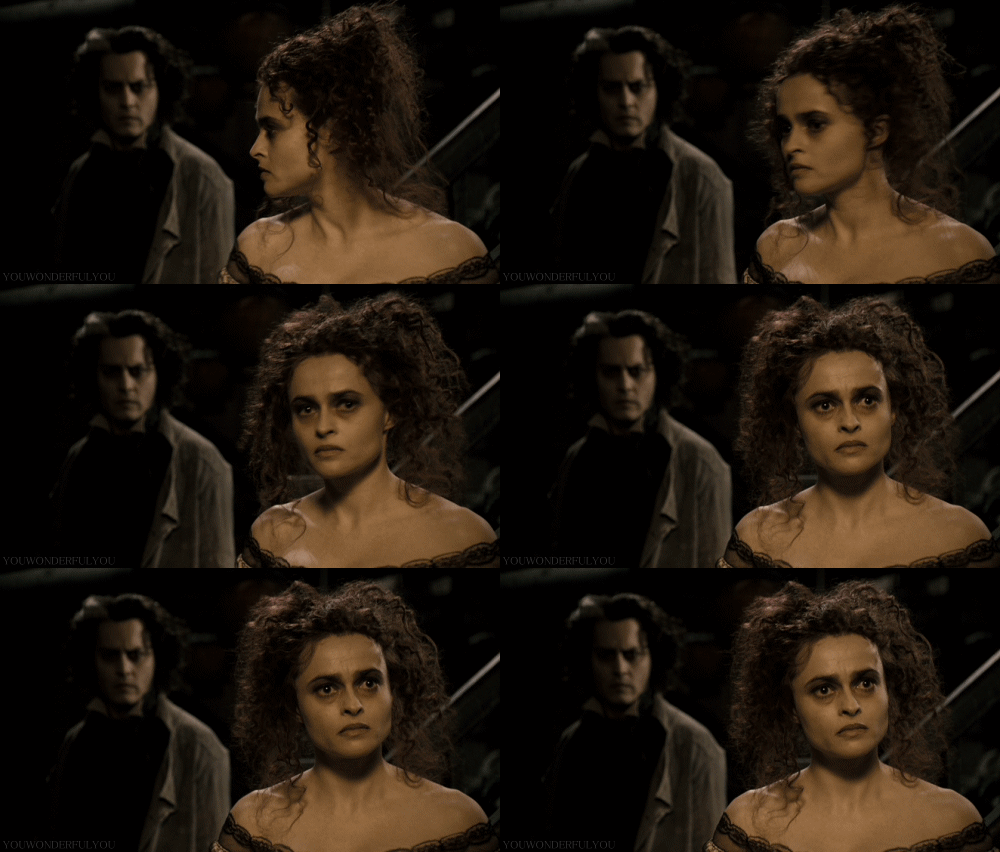
6. “The Ballad of Sweeney Todd” – Sweeney Todd
When I first watched the video recording of this show at the tender age of 9, I ran out of the room in fear at one point. Listening to the album alone gave me the creeps (mostly because of that friggin’ factory whistle). But super-creepy subject matter aside, this opening number is, in short, bad-ass. What other musical starts with the lead emerging from an oven and an ensemble calling us to the campfire for a gourmet scary story? There is not a single thing about this number that doesn't kick copious amounts of ass.


7. Candide
I’ve never actually seen Candide, nor do I know very much about it (except that it contains the greatest Broadway coloratura aria EVER). But this overture is arguably the liveliest, peppiest classical-fusion piece Leonard Benstein’s ever gifted to Broadway.  It doesn’t even give the audience a moment to breathe, so I can only imagine how the members of the orchestra handle it!


8. Gypsy
Two words: Trumpet. Solo. 


9. “Circle of Life” – The Lion King
This opening number is definitely more of a visual feast than an audio one, but Sweet Baby Jesus, it’s amazing! It almost makes the rest of the show a bit of a low because there are few points in the show higher and bigger than the opening. This number puts every Superbowl halftime show to shame ...and they typically do it twice a day.


10. West Side Story
Before a single note is played, Mr. Bernstein gets our attention with the show’s trademark short-long-short whistle (which I personally prefer as a gang signal over oddly-and-most-likely-dangerously-placed graffiti defacing public property). Then he unloads this loud, wild plethora of food for the ears with urgent tones and south of the border flavor. The clashes and interactions between the rival Jets and Sharks, the star-crossed lovers, and the law are represented in this pumping, beautiful traffic jam of an overture. *Fun fact: West Side Story didn’t do well its first time around on Broadway. Audiences weren’t quite ready for the “gritty, dark” musical genre. It lost the Best Musical Tony to Music Man that year.*


Friday, November 29, 2013

"Merrily" Gets A Makeover


I’ve been thinking a lot about a special evening at the movies last month. Theatres across the country presented a one-night screening of the West End production of Sondheim’s Merrily We Roll Along.  I don’t know if you’ve heard, but I’m a bit of a Sondheim groupie.  So anything Sondheim-related arguably makes me more excitable than a Muppet on ecstasy. However, I was pretty unfamiliar with this show going in.  I knew it owned the heartbreakingly beautiful number, “Not A Day Goes By” AND that it was Sondheim’s biggest critical and second biggest commercial flop (though it closed after only 16 performances, it still didn’t beat Anyone Can Whistle’s painful 9). Did I care? No sir-ee!  I booked my ticket and skipped all the way to the theatre. I’m glad I did buy tickets in advance, because it was PACKED (about 90% full, which is about 40% more than most drum corps show screenings I’ve been to)! I couldn’t believe the amount of people this flop drew in little ol’ King of Prussia, PA. Even more amazing was the surprisingly diverse age range (20s to Older-Than-Dirt).  I expected a bunch of blue-hairs, but not young whippersnappers like me!  But then again, unexpected sci-fi nerds of all shapes, sizes, and ages come out of the woodwork too for comic-con…

Merrily We Roll Along
Music & Lyrics: Stephen Sondheim
Book: George Furth
Broadway Debut: 1981
Tony Nominations-Wins: 1-0
Based On: George Kaufman & Moss Hart’s play of the same name


Story:
Merrily We Roll Along observes, in reverse, the lives of three friends – composer, Frank; playwright, Charley; and writer, Mary – across a span of 20 years. The show is played out in a series of reversed chronological vignettes, mapping out significant events that shape the friends’ lives and their shift from hopeful, idealistic youth to compromised and embittered middle-age.  As the years roll not-so-merrily back over twenty years of his life, we see how Frank (Friend #1) went from penniless composer to wealthy producer, and what (and who) he gave up to get there.  He begins the show as a successful Hollywood producer hosting a swinging party celebrating yet another of his hit fluff movies. Alcoholic, resentful theatre critic (Friend #2), Mary, sits in the corner, stewing.  When the sore subject of playwright, Charley (Friend #3), is brought up, Mary can stand the party’s frivolity no longer and drunkenly chastises Frank for being a sellout, insults his guests, and leaves. The years peel back to gradually reveal Frank and Charley’s catastrophic falling out (on national television), Frank’s bitter divorce as a result of infidelity with Broadway star, Gussie, and Mary’s long-lasting, unrequited love for Frank. Each of the three friends is faced with difficult decisions throughout their lives that compromise their careers, relationships, and morals.  Many of their choices are made to achieve the success they so desired in their youth, but drew unexpected consequences.

History:
Though the score was critically acclaimed (or course!), the original production was riddled with flaws and problems. Teenagers were initially cast in the lead roles (first mistake). Staging was also an issue: the audience was extremely confused and had trouble understanding what was going on in the story. Telling the story in reverse and featuring a rather unlikeable hero only complicated matters.  The confusion resulted in a last-ditch effort for clarity with the actors all wearing sweatshirts with their characters’ names on the front (second mistake).

However, former-cast-member-turned-West-End-director, Maria Friedman made some drastic changes that evolved Sondheim’s work (with his blessing, of course) into a much more engaging, relatable production. She ditched the green teenagers in sweatshirts for seasoned actors in their forties and emphasized Frank’s appealing charisma and vulnerability.  Her staging and fleshed-out characters eliminated confusion and gave the audience a likeable hero.


Message:
When asked why bother digging up such a failure of a show for a revamp, Friedman replied that it is because of the ideas all his musicals contain. “There are rarely conclusions there, just ideas so the shows can keep moving and growing, and each age group will have an entirely different take on a piece because it encompasses so many different aspects of humanity in its mess and its effort and its courage.”

I. LOVE. That!!!  His shows really are timeless and capable of reevaluation, as they push ideas over plots. Among the many things I love about Sondheim, I think he truly excels at making the audience think.  He doesn’t tell you what to think; he just forces you to think.  And there is no right answer in his shows.  Sondheim rarely gives us black and white situations because they rarely exist in reality.  Frank makes many choices in Merrily, but his choices are real and human and full of conflict.  The audience has/gets to decide if his choices were right or wrong.  He tends to do that in most of his work.  He’s not concerned with putting on a good show; he wants to communicate thoughts over plots. Sure, some of his plots are better than others.  Even though it’s received a creative overhaul, Merrily will never be Into The Woods or Sweeney Todd. But the tough, complex situations are still there, inviting us to interpretation.

In Merrily, we see the characters make choices that spiral their lives downward and away from each other. It's easy for us to say that they're doing the wrong thing or making seriously bad interpersonal moves. It's easy for us to sit and pass judgement on these people as outside observers. But how often do we make bad choices ourselves that we can only realize were wrong in retrospect.  We are rarely able to see the long term consequences of our actions in the present.  We can only look back and determine after the fact if we made the right decisions.  As the reverse chronological order of the show reflects, we can't look into the future and see where we end up. We can only look back into the past and see how far we've come.

In a world of tablets and Playstations and iPhones, where we can play on autopilot ant get any information we desire by pressing a button, it’s truly refreshing to still have an abstract outlet that compels us to think for ourselves.  You get a composer like Andrew Lloyd Webber (I’m really not trying to trash ALW, he’s just a good example!), whose work is like an ice cream bar.  You can throw a plethora of toppings and sauces and flavors on it, but at the end of the day, it’s still just a scoop of ice cream underneath. Then you look at Sondheim and you’ve got a succulent, gourmet dessert buffet.  You’ve got rich, decadent chocolate; fluffy, sweet cream; tart fruits and berries; bitter coffee (optional)… Sondheim is, in short, a festival of flavor.  It’s never just one taste or sense or emotion.  You have a whole buffet to choose from!

Thursday, October 31, 2013

THAT’S Your Favorite Musical? - Part 3

Happy Halloween, campers!  We have come to the third and final installment of musicals I just don’t get.  I’d like to reiterate that everyone is entitled to their opinion on these musicals and you are free to voice them.  Except for Oliver! I’m sad to say I don’t think you’ll ever change my stance on that show.   We will conclude the “THAT’S Your Favorite Musical?” series with the (for some reason) West End and Broadway smash, Evita.

Evita
Based on: Life of Argentine First Lady Eva Peron
Music: Andrew Lloyd Webber

Lyrics: Tim Rice
Broadway Debut: 1979
Tony Nominations-Wins: 11-7


High points of Evita:
·         Mandy Patinkin. Need I say more? He belts like a boss!
·         The music
Low points of Evita:
·         Patti Lupone. See below.
·         The plot (historical ambiguity and failure to create empathy)

The only exposure I’ve had to Evita is the original cast recording, that God-awfulnumber Ricky Martin and Nurse Ratched’s sister did at the 2013 Tonys, and the Madonna film.  I don’t think the film is terrible, I just think Antonio Banderas is the only one who has a clue what the frak he’s doing there….. Mmmm, Antonio!!!  He should do more Broadway.  I’m such a sucker for them triple-threats!  But seriously; Jonathan Pryce just stood (and sang) there like a prop while looking lustfully at Madonna, who was just happy to be there, always singing a key lower than the original score.


Evita follows the brief life story of street-scamp-turned-actress-turned-spiritual-leader-of-Argentina, Eva Peron.  Brought up in impoverished Junín, she tags along with a tango singer to happenin’ Buenos Aires to make her fortune at the tender age of fifteen.  She makes her way up the social ladder to the rank of “established radio actress” by way of numerous trysts with increasingly prominent gentlemen.  Then she meets the significantly older Col. Juan Peron at some fancy shindig.  They hook up.  Rich people and the military don’t approve.  They get married.  Rich people and the military REALLY don’t approve.  She gets up on a balcony in a ball gown and tells the Argentinians that they shouldn’t cry for her.  Pandemonium! Then she gets all dolled up and tours Europe to try and gain favor with other nations, receiving mixed reviews.  She comes home and creates a charity foundation that happens to line her own pockets quite nicely.  She gets uterine cancer and dies at 33. Argentina is beside itself.  Juan sticks her in a glass coffin and has a bunch of embalming preservatives pumped into her (I’m guessing he had some Snow White fascination or something, cuz that’s just creepy). The End.

I spent the majority of this musicalrockoperawhatever thinking so what?  Yeah, she made her way from a bastard street urchin to spiritual leader of Argentina and stuck it to the elite who snubbed her.  Yeah, she was a champion for the descamisados, but she also manipulated her fascist husband’s political movements, screwed over countless people and organizations to fund her charity foundation (*cough* money laundering *cough cough*), and she was an avid Nazi sympathizer (it’s widely speculated that her European “Rainbow” tour was a front to help transport former Nazis to South America).  Why should I invest in this story emotionally?  She gives me no reason to like her.  I give a bigger shit about Che’s character than hers (and he’s not even a “real” character). So whenever she’s got her hands raised up on the balcony going, “Oh, my impoverished Argentine people, I LOVE you!” I’m just thinking How nice, the power-hungry, full-o-crap tyrant with a better wardrobe than Kate Middleton loves her people… still don’t care.  The only conclusion/revelation Evita seemed to come to at the end was her “choice” to be a shining flame that dies quickly instead of being a slow-and-steady success from the sidelines (right, cuz uterine cancer had nothing to do with it). That’s kind of selfish if you ask me.  I wonder if Jackie Kennedy ever had problems like that… 

I do like the songs; very catchy, memorable, hummable, pretty, sweeping melodies. The usual Andrew Lloyd Webber recipe. However, does anyone else notice Andrew Lloyd Webber’s habit of recycling the same tunes? Phantom, Joseph, Cats, Sunset Blvd, etc. He writes 7 tunes for each show and just has his lyricist write different lyrics each time they occur. Y’know that song “Don’t Cry For Me, Argentina?”  Well, it’s also pretty much the same tune as “Oh, What A Circus,” “The Actress Hasn’t Learned The Lines,” and “Eva’s Final Broadcast.”  I’m cool with a reprise from time to time, but that’s just being lazy.

There are a two songs that make little sense to me: “Don’t Cry For Me, Argentina” and “Another Suitcase In Another Hall.” “Don’t Cry…” finds Evita bidding the rabble below not to mourn her ascent to stardom, as she still remembers where she came from and loves her kinsmen.  Cue the puke machine! Please, you’re wearing Dior and we’re supposed to find you endearing because you used to be poor?  LAME.  I’d be cool if she sang that after she was dead or something, but you sound like a pompous ass when no one’s crying yet.  I’m pretty sure the reason she always has her hands raised during this song is because she’s holding up an imaginary cross.  And I’m not alone on this.

I fuckin' OWN this place...
I actually like the song “Another Suitcase In Another Hall.” Peron’s mistress sings about moving on from her failed relationship after Evita unceremoniously supplants her.  A fitting song.  Crap, my lover/sugar daddy found a new hussy and I’m out on my ass… However, I feel kinda bad that this lady with such a good song gets no character development, no addition to the plot, not even a name (she’s only referred to as “Mistress”).  It’s kind of a weird stop in the action of the show. We’re following Evita’s speedy rise to power and then we’re sideswiped with having to listen to this sad, nameless chick who just came out of nowhere…. And then she’s gone, never to be seen again.  At least it made some sense when Madonna sang it in the movie (remember that tango singer? Well, he jilts her as soon as they get to Buenos Aires in the movie).


I've got a glass of Bitch Juice and I ain't afraid to throw it in your face!!!
And what about Patti Lupone?  I would dedicate an entire post to my disdain for Patti Lupone, but I’m pretty sure that if she ever read it, I’d never be seen again.  In one of my favorite quotes from The Great Gatsby, Jay Gatsby describes the nature of blithe socialite, Daisy, affirming, “Her voice is full of money.”  In my opinion, Patti Lupone’s voice is full of Patti Lupone.  She’s an unabashed diva (not the good kind).  At a performance of Gypsy (which, I believe she demanded be revived on Broadway about 5 minutes after Benradette Peters’ version closed, just so she could play Mama Rose), she stopped the entire show to rant at an audience member for trying to take a picture with his phone.  Now phone use is obviously bad form at a performance, but is it the job of a performer to point that out?  I’m pretty sure if any other cast or crew member had pulled that shit, they’d be on unemployment the next day.  The show must go on, right? ….I guess not if you’re Patti Lupone and someone in the house is pissing you off.  According to her own memoirs, she trashed a dressing room and threw a lamp out the window because they didn’t cast her in Sunset Blvd. when it went to Broadway.  So in a way, I guess the role of Evita is perfect for her: spiteful, entitled, tyrannical…

I will grant you, she has some powerhouse pipes. But when I hear her sing, I hear no character, no richness, no color, no lilt, no enunciation; just a bunch of shrill, slurred notes being adequately hit (and I have heard her live… 2nd worst Mrs. Lovett ever).  Her brassy voice is reminiscent of Ethel Merman, but without the personality.  Her singing range consists of Loud and Really Loud. Her emotional range consists of Lethargic and Slightly Irritated.  Have you ever been in a choir where there’s always that one singer who refuses to blend?  Yeah, that’s Patti.  She’s just not for me…

B.A.M.F.
So that’s my take on Evita.  Not a bad work, just severely overhyped.  But good for Argentina.  The rest of the world can probably find it on a map now, thanks to Andrew Lloyd Webber.  I believe the only rave-worthy thing about this show is Mandy Patinkin (and maybe Madonna’s 9,000 costume changes in the movie version).  I don’t care what he sings, he makes the show (and life in general) wonderful.  He could be singing The Brady Bunch theme song and I’d still be geeking out.  But he can only make up so much for the glorified puffery that is Evita’s appeal.  That too harsh for you? Well, you can go to Argentina and cry about it…