Showing posts with label song. Show all posts

Sunday, March 2, 2014

Something Wonderful - It's good to be The King

My last post was a Top 10 list (in no particular order of preference) of my personal favorite Broadway love songs, in honor of Valentine’s Day. Feel free to go back and have a listen. I’ll wait…


Welcome back! Today, we’re going to discuss the musical that featured song #7 on that list (“Something Wonderful,” for those of you who didn’t feel like having a listen): The King & I.
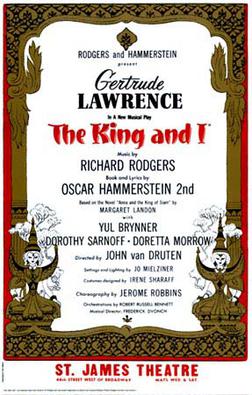
 
The King & I
Music: Richard Rogers
Lyrics: Oscar Hammerstein II
Based On: Margaret Landon novel, Anna and the King of Siam
Broadway Debut: 1951
Tony Nominations/Wins: 5/5


I’ve been thinking about “Something Wonderful” for a while now. It’s not one of those songs about loving someone even though they drink or beat you… or both (i.e. “What’s The Use Of Wond’rin’”, “As Long As He Needs Me”, “Can’t Help Lovin’ Dat Man”). It’s more than being a powerless slave to love, despite the man’s shortcomings. This is a song in which the singer loves a man for all the good he’s capable of if he has the right kind of help. At one point, Lady Thiang says, “I am not equal to his special needs.” She is filled with borderline sorrow over not being able to adequately support her conflicted husband, who is flawed beyond mere infidelity (though the guy does have a plethora of wives). She sings about loving a man who needs patience, understanding, brutal honesty, and an ego stroke all at the same time to succeed which she pleads for Anna to give him since she herself cannot. The King is doing very important things and making very important decisions to balance the eastern and western influences in his country and help his people thrive. He was raised on ancient traditions and cultures that demand he show no vulnerability whatsoever. He simultaneously needs to make way for modern advances to prove his prowess and compatibility to the rest of the world while not forcing his nation to adopt change too quickly.  Lady Thiang understands this, but can only watch from the sidelines while he and Anna work it out together.


The King & I raises a lot of fascinating interpersonal commentary in just 3 hours, particularly from the King of Siam (the real King Mongkut was actually pretty fascinating too, but more about him later). At first glance, the King comes across as an obstinate, vain, bully. Then the brilliant songs start and we are plunged into the abyss of the human condition.  The King is aware of the monumental burdens he must shoulder. In “Is A Puzzlement,” he feels extreme conflict about his uncertainty in fields that he believes he should have a firm grip on (since he’s king and all); like what values to instill in his eldest son that will make him a fair, yet dynamic king (and human being) his people will follow.  He grapples with maintaining his country’s traditional eastern identity and monarch-headed system of government while embracing the modern, western cultural influences that will assure his country remain a competitive force among the civilized nations of the world. This conflict eventually gets the best of him.  Anna’s influence strips him of his previous sense of self and throws him into an even bigger pit of conflict and moral pressure. He hands his beloved monarchy over to his son, who begins making big, modern changes for the kingdom, and (**SPOILER ALERT**) dies. It may be good to be the king, but it sure ain’t easy!


On a personal level, the King is a stern disciplinarian with his wives and children. But in “March ofthe Siamese Children,” he is clearly also a loving father. He exerts austerity because he cares about their future and wants them to be educated.  But he shows signs of softness, particularly towards the younger ones. He views his wives as subservient, demure beings, meant to do his bidding. When he first hires Anna, a woman, to teach his family, he expects her to be similar to the other women he’s grown accustomed to in his life. She blows his mind with her intellect and contending demeanor. This eventually grows into a mutual respect and a deep, unspoken love. She becomes what none of his wives, including Lady Thiang, could ever be: an equal confidante. They may butt heads in the beginning; a result of the eastern and western culture (and gender) clash, but once they let each other in emotionally and embrace each other’s positive cultural and personal attributes, they are able make beautiful music together.


Fun Facts:
The real Anna Leonowens was actually Eurasian! She told people she was of Welsh descent to explain her darker skin color. This fact wasn’t discovered until after The King & I was written.

When Gertrude Lawrence (the original Anna on Broadway) died, she was buried in her 75 pound “Shall We Dance?” ball gown.
The real King Mongkut was highly accomplished in his own right: before succeeding his older brother as king, he was a Buddhist monk (and founded a reform order of Buddhism), a multi-lingual scholar, a mathematician, an astronomer, and he set up Siam's first printing press, to print in both English and Siamese… And I thought Yul Brynner was a badass! 

Saturday, February 15, 2014

A Belated Valentine's Day Top 10

Ah, Valentine's Day. That special day of unbridled romance, chocolates, fancy dinners, Durex, price-hiked flowers, and probably some disappointment.

....And romantic music!!! What better gets us in the mood than some Marvin Gaye or some Righteous Brothers, stimulating our sex organs into a pottery-spinning frenzy?! What makes our hearts soar and eyes tear up better than a song proclaiming everlasting love and devotion? I'd like to commemorate this Valentine's Day with MY Top 10 favorite musical love songs.


The world's general top three favorites seem to be "If I Loved You", "All I Ask Of You", and "Some Enchanted Evening" (this one actually made my list). "If I Loved You"is a truly beautiful and heartfelt song, but I think it's too timid for Valentine's Day. I need a love song that screams of love from the rooftops. "If I Loved You" is all about what you would say if you were brave enough to say it (a cop out in my opinion). "All I Ask Of You" is also a beautiful song, with even more beautiful music. But in the context of the show, I think Raoul is more about comforting and assuring Christine's protection, who is so vulnerable, she enlists Raoul as her personal bodyguard-slash-boyfriend for the rest of time.  I think at this point in the show (if they were smart), they should be talking about searching the opera house for that stalker guy in a mask who murdered that poor stagehand about five minutes ago (and maybe getting Christine some therapy for her Stockholm Syndrome). But no, you're just gonna sit on the roof and proclaim your love for each other. Good for you.
You're even more beautiful up close than when I stare at your through the trick mirror!

I'm going against the grain and making a (short) case for each of my selections, for I believe they contain some of the most romantic, sentimental, schmaltzy, beautiful lyrics and/or music to ever grace a Broadway love song. So allow me to present (in no particular order of preference, just alphabetical) my 2014 Top 10 Favorite Broadway Love Songs:


1. How Could I Ever Know? - Secret Garden
In this gut-wrencher of a song, long-suffering widow, Archibald Craven (played by the am-AH-zing Mandy Patinkin) is visited by his deceased wife, Lily. She apologizes for the pain he's endured from her death and encourages him to stop mourning her and be a presence in their son's life. I mean, of course it's not her fault she's dead, so she doesn't really have any reason to be apologetic!  But to cross back over into the world of the living to help your husband move on after tragically losing you?  That's love, man...

2. Love Can't Happen - Grand Hotel
I never personally believed in the concept of "love at first sight." But Brent Barrett makes me want to be a believer!  Barrett's character, Baron Felix, meets an aging ballerina while attempting to rob her hotel room and "loses himself completely." The sweeping score and climactic belting turn me into a swooning mess of estrogen.

3. Love Song - Pippin
I'm a tad obsessed with this song at the moment. Pippin was the most recent show I've seen (technically Chicago was the most recent, but they were on the same day), so it's still fresh in my mind. There's nothing dramatic or grand about this song. But I think it's a very sweet, intimate song that magnifies the importance of all the "little things" that make a relationship special.

4. Not A Day Goes By - Merrily We Roll Along
I know this song's about a breakup, but you can't appreciate happiness without a little sadness. Even after a relationship ends, the love doesn't necessarily end, as much as you may want it to. In the misunderstood flop, Merrily We Roll Along, the done-wrong wife sings of how her two-timing husband is still in her mind and her heart. Here, the queen of the heart-wrench, Bernadette Peters practically crushes her own soul on stage for the sake of our earballs' entertainment. Bless you, Bernadette!

5. Say It Somehow - Light In The Piazza
http://www.youtube.com/watch?v=4Iob_JngT2Y
Out of my entire Top 10, I gotta say this is the song that reduces me to a blubbering mess the most (especially right when she says "I always understand"). ERMERGERRRRRD!!! It's such a passionate and pure song that breaks and transcends language barriers. Even though Fabrizio and Clara aren't able to easily articulate their feelings, they still know each other's hearts and get the message across even when words fail. Plus a little touch of looming danger at the end is always fun!

6. Some Enchanted Evening - South Pacific
I can't fight the masses completely. This song is good. Really good. Plus it never hurts when Brian Stokes Mitchell (in a tux... a white tux!) sings it. Seriously, if dark chocolate had a voice.... Such a lovely song about spotting a moment that you know is special and vowing to hold onto it.*Sigh* Good stuff.

7. Something Wonderful - The King & I
Lady Thiang pleads with "Meesus Ah-na" to assist her husband, the King, with his kingly affairs, as he is unable to tackle them on his own. I like this song because it's all about loving someone who is not just imperfect, but someone who truly requires your help to get by. It's tough enough to be in a regular, mutual relationship. But to be in love with someone with serious faults who needs you more that they realize and may or may not show appreciation for you? That's tough. And incredibly loving.

8. Song On The Sand - La Cage Aux Folles
This is a very sweet "we-stood-the-test-of-time" song. Georges recalls meeting his longtime love, Albin, how special that day was, and how their love is just as strong today.

9. The Next Ten Minutes - The Last 5 Years
The song starts out with the small request of sharing the next 10 minutes together. Then by the end of the song, he wants ten lifetimes with her. The musical follows Cathy and Jamie through their 5 year relationship: Jamie starting at the beginning and going forward, Cathy starting at the end and working back. For this one song in the show, they meet in the middle and sing together. This is the one time when they're in sync in their relationship. I think I love the harmony at the end of this song more than anything. It just screams chemistry!

10. Unexpected Song - Song & Dance
I don't know much about this show, but I do love this song.  There's nothing more exciting than new love blossoming. This song highlights every emotion, every thrill, and every butterfly just beautifully.

So there you have it folks. My Broadway Love Songs Top 10 of 2014! Agree? Disagree? Did I leave any out?  Share yours and we'll discuss!


Honorable Mentions:
The More You Ruv Someone - Avenue Q

The Song That Goes Like This - Spamalot

Touch Me - Spring Awakening (this is more of a sex song than a romantic song, but I find it pretty hot)

Songs With A Person's Name in the Title
* Johanna - Sweeney Todd
* Maria - West Side Story
* Dulcinea - Man Of La Mancha

Saturday, February 1, 2014

Oh, the Negro and the Hebrew Should Be Friends! A Study of Dual Guilt, Persecution, and 11 o’ clock Numbers


DISCLAIMER: If you’re overly sensitive, this post may touch on borderline racism, so I apologize in advance.  But then again, everyone’s a little bit racist!


I was listening to XM Broadway Radio in my car the other day and before treating my eager ears to Norm Lewis nailing “Bess, You Is My Woman Now”, Seth Rudetsky (I think it was Seth) mentioned how the most soulful, memorable musical numbers sung by powerful black characters (i.e. “And I Am Telling You I’m Not Going”, “I Know Where I’ve Been”, “Ol’ Man River”) are often written by old, white, Jewish men. I found this observation fascinating. It also raised a few questions:

1) How are Jews so good at writing these songs?
2) With all the persecution and hardship they have in common, why aren’t African Americans and Jews better buddies?
3) Why aren’t black people writing these songs themselves?


As a white, Jewish female, I may be biased in this study. But I’m throwing it out into the universe anyway!

1) How are Jews so good at writing these songs?
What the frak do old, white, Jewish men know about spirituals and gospel numbers?  It’s truly amazing how you get a bunch of very talented songwriters who grew up with klezmer-flavored music and Yiddish-speaking parents, yet they crank out stuff like this!

"Okay, how does this sound? '...Fish are jumpin' and the cotton is high.'"
If you were lucky enough to catch WHYY’s piece on the Jewish legacy in musical theatre, it touches on how the great early 20th century Jewish composers of the time (Berlin, the Gershwins, Hammerstein) would draw on segments of their own culture’s music and develop it into songs for musical theatre. The program also mentioned how both turn-of-the-century Jewish klezmer music and African American spirituals/folk hymns tended to be in a minor key. Songs in minor tend to have a sadder, more melancholy tone than songs written in a major key. This musical familiarity between the two made an easy transition from ‘da Blues to ‘da stage.


2) With all the persecution and hardship they have in common, why aren’t African Americans and Jews better buddies?
Pre-turn-of-the-century Jewish and African American songwriters also shared a very mutual antagonist, which clearly seeped into their cultural music: oppression, discrimination, and woe.  Who carries their ancestors’ hardships on their backs and wears it as a badge of pride better than the Jews and African Americans? You would think with the amount of slavery, persecution, culture, and misery Jews and African Americans have racked up throughout the last few centuries (not counting the extra couple thousand years the Jews have accrued), they’d have a very strong, common bond.  Instead, they seem deadlocked in a Who’s-The-Bigger-Victim pissing contest. The lack of Jewish and African American camaraderie arguably roots from several schools of thought: Ignorance, Self-importance, politics, excessive use of the race card, and flat-out racism.  Or is the thought of a mutual respect between such large groups extremely naïve? I mean, are there really any cultural partnerships like that? Or are all the world’s ethnic/racial/religious groups just locked in a collective passive-aggressive dislikefest (some less passive than others)?

"Okay, let's get Father Flanigan and walk into a bar. It'll be hilarious!"
3) Why aren’t black people writing these songs themselves?
Even if they don’t get along on an everyday basis, you’d think they’d be bosom buddies in the entertainment industry.  I get it. Broadway is primarily a white, upper-middle-class people’s game. Always has been.  The majority of African Americans would most likely rather play in oncoming traffic than sit through a musical (and pay top dollar to do it). But why is this? African Americans have made monumental contributions in entertainment, art, literature, and music.  It’s not like they don’t have a reputation for producing brilliant art. The talent’s there.  Why not bring it to the stage, where it’s truly appreciated? But now we’re back to the white people’s game.  I’ll admit it’s not historically easy to attract black theatregoers.  In recent all-or-mainly-black cast productions performed on Broadway, African American audiences were typically drawn to the star power tied to the shows (The Wiz, Oprah heavily endorsing The Color Purple, P-Diddy-or-whatever-his-name-is-now in Raisin in the Sun, James Earl Jones in Cat on a Hot Tin Roof, etc.). The shows without big star power typically had less of a turnout from the black community (Passing Strange). I personally frown on most mainstream stars invading Broadway (like Disney Channel kids and American Idol runner ups and former boy band members). But if that’s what brings a more diverse crowd, I say give ‘em what they want. If that’s what brings people to the theatres and potentially inspires them to create similar work, bring it on. And if you really want to get integrated, who says typically-white characters can’t be black?  Belle was black for a while when Toni Braxton had her stint on Broadway and people loved her! I’d be very interested to see the general reaction to a black Cinderella or Galinda or Phantom! 


The early 20th century saw a slew of successful and popular all-black productions, propelled by the Harlem Renaissance. Minstrel shows and blackface stereotypes were rejected in favor of serious, home-hitting subject matter that appealed to both black and white audiences (when they were integrated, which was a revolutionary concept, only beginning to see the light of day). African Americans used art to prove their humanity and demand for equality when it was widely denied them. The Harlem Renaissance not only led to more opportunities for blacks in white mainstream circles, but also developed a sense of ethnic pride and identity.  The explosion of culture lifted African Americans at the time to a higher, respected status.

I say we should bring that mentality and identity back. And I don’t mean Kanye or whoever rapping about the joys of being an overpaid, overdrugged, oversexed gangsta.  Even though that’s obviously what sells today, I can’t imagine that it is the only profitable subject matter in the current black music style. Look at Will Smith! While other rappers were rapping about shooting people and gangs and inflating their already astronomically-entitled egos, he rapped about how his caring mother sent him tolive away from the hard streets ofWest Philadelphia.

My point is “Thug Life” is just that: Thug Life.  They know what sells and what attracts the masses. But they’re obviously better than that.  And while I’m at it, that goes for the white people too! Some people have talent and some people have a talent for entertaining. Don’t settle for a pair of tits or a boy band haircut singing a mindless-though-catchy pop tune!  Let talent live and breathe outside the singing competition shows!  …Sorry, I digress. African Americans used to be a driving force for good in our country’s culture and on our stages.  In comparison, it’s just pandering amusement and shock value now.  I don’t see why they can’t be a force on Broadway again. I would have given my *insert sexual appendage here* to see the all-black cast rendition of Hello Dolly! (headed by Pearl Bailey).

I think musical theatre is the greatest means of creative expression in the world.  So why is it such a whitewashed institution? You see a “person of color” on or behind the scenes here and there. You see an ethnically-charged show here and there.  But why, in a community that is so outgoing and inclusive and open to diversity, is race still a hurdle?  I highly doubt Broadway is turning black artists away; I just wonder how many are showing up.  Maybe things would change if we could get Jay-Z to be in a musical…

Friday, November 29, 2013

"Merrily" Gets A Makeover


I’ve been thinking a lot about a special evening at the movies last month. Theatres across the country presented a one-night screening of the West End production of Sondheim’s Merrily We Roll Along.  I don’t know if you’ve heard, but I’m a bit of a Sondheim groupie.  So anything Sondheim-related arguably makes me more excitable than a Muppet on ecstasy. However, I was pretty unfamiliar with this show going in.  I knew it owned the heartbreakingly beautiful number, “Not A Day Goes By” AND that it was Sondheim’s biggest critical and second biggest commercial flop (though it closed after only 16 performances, it still didn’t beat Anyone Can Whistle’s painful 9). Did I care? No sir-ee!  I booked my ticket and skipped all the way to the theatre. I’m glad I did buy tickets in advance, because it was PACKED (about 90% full, which is about 40% more than most drum corps show screenings I’ve been to)! I couldn’t believe the amount of people this flop drew in little ol’ King of Prussia, PA. Even more amazing was the surprisingly diverse age range (20s to Older-Than-Dirt).  I expected a bunch of blue-hairs, but not young whippersnappers like me!  But then again, unexpected sci-fi nerds of all shapes, sizes, and ages come out of the woodwork too for comic-con…

Merrily We Roll Along
Music & Lyrics: Stephen Sondheim
Book: George Furth
Broadway Debut: 1981
Tony Nominations-Wins: 1-0
Based On: George Kaufman & Moss Hart’s play of the same name


Story:
Merrily We Roll Along observes, in reverse, the lives of three friends – composer, Frank; playwright, Charley; and writer, Mary – across a span of 20 years. The show is played out in a series of reversed chronological vignettes, mapping out significant events that shape the friends’ lives and their shift from hopeful, idealistic youth to compromised and embittered middle-age.  As the years roll not-so-merrily back over twenty years of his life, we see how Frank (Friend #1) went from penniless composer to wealthy producer, and what (and who) he gave up to get there.  He begins the show as a successful Hollywood producer hosting a swinging party celebrating yet another of his hit fluff movies. Alcoholic, resentful theatre critic (Friend #2), Mary, sits in the corner, stewing.  When the sore subject of playwright, Charley (Friend #3), is brought up, Mary can stand the party’s frivolity no longer and drunkenly chastises Frank for being a sellout, insults his guests, and leaves. The years peel back to gradually reveal Frank and Charley’s catastrophic falling out (on national television), Frank’s bitter divorce as a result of infidelity with Broadway star, Gussie, and Mary’s long-lasting, unrequited love for Frank. Each of the three friends is faced with difficult decisions throughout their lives that compromise their careers, relationships, and morals.  Many of their choices are made to achieve the success they so desired in their youth, but drew unexpected consequences.

History:
Though the score was critically acclaimed (or course!), the original production was riddled with flaws and problems. Teenagers were initially cast in the lead roles (first mistake). Staging was also an issue: the audience was extremely confused and had trouble understanding what was going on in the story. Telling the story in reverse and featuring a rather unlikeable hero only complicated matters.  The confusion resulted in a last-ditch effort for clarity with the actors all wearing sweatshirts with their characters’ names on the front (second mistake).

However, former-cast-member-turned-West-End-director, Maria Friedman made some drastic changes that evolved Sondheim’s work (with his blessing, of course) into a much more engaging, relatable production. She ditched the green teenagers in sweatshirts for seasoned actors in their forties and emphasized Frank’s appealing charisma and vulnerability.  Her staging and fleshed-out characters eliminated confusion and gave the audience a likeable hero.


Message:
When asked why bother digging up such a failure of a show for a revamp, Friedman replied that it is because of the ideas all his musicals contain. “There are rarely conclusions there, just ideas so the shows can keep moving and growing, and each age group will have an entirely different take on a piece because it encompasses so many different aspects of humanity in its mess and its effort and its courage.”

I. LOVE. That!!!  His shows really are timeless and capable of reevaluation, as they push ideas over plots. Among the many things I love about Sondheim, I think he truly excels at making the audience think.  He doesn’t tell you what to think; he just forces you to think.  And there is no right answer in his shows.  Sondheim rarely gives us black and white situations because they rarely exist in reality.  Frank makes many choices in Merrily, but his choices are real and human and full of conflict.  The audience has/gets to decide if his choices were right or wrong.  He tends to do that in most of his work.  He’s not concerned with putting on a good show; he wants to communicate thoughts over plots. Sure, some of his plots are better than others.  Even though it’s received a creative overhaul, Merrily will never be Into The Woods or Sweeney Todd. But the tough, complex situations are still there, inviting us to interpretation.

In Merrily, we see the characters make choices that spiral their lives downward and away from each other. It's easy for us to say that they're doing the wrong thing or making seriously bad interpersonal moves. It's easy for us to sit and pass judgement on these people as outside observers. But how often do we make bad choices ourselves that we can only realize were wrong in retrospect.  We are rarely able to see the long term consequences of our actions in the present.  We can only look back and determine after the fact if we made the right decisions.  As the reverse chronological order of the show reflects, we can't look into the future and see where we end up. We can only look back into the past and see how far we've come.

In a world of tablets and Playstations and iPhones, where we can play on autopilot ant get any information we desire by pressing a button, it’s truly refreshing to still have an abstract outlet that compels us to think for ourselves.  You get a composer like Andrew Lloyd Webber (I’m really not trying to trash ALW, he’s just a good example!), whose work is like an ice cream bar.  You can throw a plethora of toppings and sauces and flavors on it, but at the end of the day, it’s still just a scoop of ice cream underneath. Then you look at Sondheim and you’ve got a succulent, gourmet dessert buffet.  You’ve got rich, decadent chocolate; fluffy, sweet cream; tart fruits and berries; bitter coffee (optional)… Sondheim is, in short, a festival of flavor.  It’s never just one taste or sense or emotion.  You have a whole buffet to choose from!

Saturday, October 26, 2013

THAT'S Your Favorite Musical??? - Part 2


Greetings to you, fellow musical addicts (or people who should be musical addicts if you’re reading this blog)!  We have come to entry #2 of musicals whose popularity and acclaim I simply do not comprehend. Feel free to peruse Musical #1 and state your opinions (even though I’m right)!  


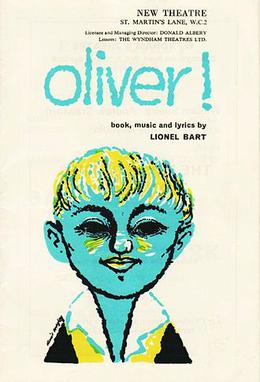
Oliver! (Yes, that exclamation point is there intentionally. What-ev...)
Based on: Charles Dickens’ novel, Oliver Twist
Music, Lyrics, Book: Lionel Bart
Broadway Debut: 1962
Tony Nominations: 10 (only won 3, because Forum SWEPT that year!!!)

Like My Fair Lady, I also walked out at the intermission of this show at the Media Theatre because it was simply unbearable (don’t blame the Media Theatre for this.  They actually put on really good stuff!).  I will admit off the bat that I may be overly harsh with my views on this show, as I have had minimal exposure to it.  I’ve never read the book or seen the show all the way though (However, I did make my way through a 7 part community theatre production of the show on YouTube just to say I’d done my homework.)  But I gotta say the exposure that I have had has been quite off-putting.

Oliver! follows the journey of a wholesome little British orphan boy: Brought up in a workhouse, he gets kicked out and sent to live with an undertaker after asking for more dinner.  He soon escapes the undertaker and ends up with a gang of minor pickpockets and their seedy criminal coach, Fagin.  And on top of all that 19th century London sadness, Oliver gets wrongly tagged at the scene of a botched handkerchief heist, but the wealthy victim of said crime (who turns out to be Oliver’s relative) takes him in, much to the chagrin of Fagin and sociopath, Bill Sikes, who believe that Oliver would rat them out.  So after several hijinks, some kidnap attempts, a murder, and a deus ex machina, all is well in the end for our orphan with a heart of gold.
We’ll start with the cockney accents.  I must say they bother me.  Immensely.  I don’t know which cast version I’ve had the displeasure of hearing, but they did not hire the most pitch-aware children, if you get what I mean.  My flesh crawls every time I hear the intro to any of the child ensemble numbers. It abuses my earballs enough when adults sing flat. But when you’ve got children singing flat WITH Cockney accents, you’re just being mean.  I don’t care if you’ve got 20 of the greatest 9 year-old boy singers on the planet; someone’s gonna be flat. However, it’s a British show and I guess British people get it. They clearly did something right. It ran at the West End for 2,168 performances! Some Americans get it (apparently), but it’s truly a British piece.  Not an American piece with British characters or a British setting.  100% British.  Does this mean I’m anti-British?  I like some British stuff: Dr. Who, fish & chips, those awesome red phone booths, the Spice Girls (in small doses), Monty Python & the Holy Grail, and those little hats Kate Middleton wears (she’s so hoity-toity, it makes my teeth hurt!). So I don’t think I’m anti-British; must be the show is shitty and everyone else is a sucker!

I understand the significance of the book, as it covers the then taboo matters of child labor, child crime, class clashes, and poverty.  It’s classic (British) literature.  A timeless novel, blah, blah, blah.  But is this just a case of a popular book on stage? That’s nothing new.  But just because it’s a beloved book doesn’t mean it’ll make a good musical. Look at Carrie! And vice versa.  Just because it’s a great musical doesn’t mean it’ll make a great movie (I’m lookin’ at you, Into the Woods.  You’re already on very thin ice with that sorry excuse for a cast. Did Les Miz + Russel Crowe not teach you anything?  You better not eff this up, Rob Marshall!)

I have read the synopsis for this show and I just find myself thinking, “So what?”  If Oliver had walked up to ask for more breakfast and the gruel dispenser guy in the cafeteria just said “No, you don’t get any more. Now go sit down, ya little punk,” the story would be over much quicker and I would be just as happy.  At least we would have bypassed that drawn out declaration of “Ooooooooollliiiiivvaaaahh!” in the titular second number.  And technically, with that deus ex machina where some beggar with a stolen locket (that belonged to Oliver’s mother/Mr. Brownlow’s niece) shows up, Oliver most likely would have ended up with his moneybags relative in the end anyway.  So all that gallivanting with singing pickpockets was kinda unnecessary at the end of the day.

Now let’s look at the songs. With an exception here and there, most of these songs (to me anyway) sound like they could have been written by some teenagers for a school project on Oliver Twist.  I gather very little feeling and/or plot progression from them.  Take “Food, Glorious Food” for example. Check out this little snippet of lyrics:

Oliver Twist
Food, glorious food!
Don't care what it looks like --
Burned!
Underdone!
Crude!
Don't care what the cook's like.
Just thinking of growing fat --
Our senses go reeling
One moment of knowing that
Full-up feeling!


Clearly these kids are hungry and dream of eating from the big kids’ buffet.  But do we need a wordy, banal filler song to convey that?  And the same goes for just about all the other stop-the-show-and-sing numbers in this show.  I’m aware that I’m a bit of a snob when it comes to music and lyrics. I want there to be substance and emotion in a show tune.  And I don’t mind if there’s a lame song or two thrown into an otherwise golden score, but I’d say about 90% of the songs in this show don’t deliver for me and resemble a brood of melodic love-children stemming from an evening with a rhyming dictionary.
  
2013-05-17-LizLemonOhBrother.gifI will admit to enjoying the ballads, “Where Is Love” and “As Long As He Needs Me.”  However (FYI), the latter is sung by Nancy, a backstreet girl in a severely abusive relationship with the aforementioned sociopath, Bill Sikes.  That said, I can’t really condone her character singing it. Now I’m really not trying to be a feminist here (see Part 1 for views on Eliza Doolittle’s pathetic moral stance), but what is the deal with these passive female characters inviting their men to step all over them?!  Eliza’s just lame for doing her thing, but Nancy’s thought process is not only wrong, it’s harmful (and fatal) to her health!  That song also puts the writers in a spot if they ever want to do a revival (or a movie. See below).  Portraying domestic violence as an acceptable thing is “no bueno” in today’s media. When I saw Fiorello in NYC last year, they changed some unsavory-by-today’s-standards lyrics in a song that brings up domestic violence in a particular verse. So in this case, how can anyone change the lyrics to 1) One of the most popular, well-known songs in the show? and 2) A song where ALL of the lyrics are about staying with someone because you’re in “love” after they proceeded to beat the shit out of you? Maybe Britain’s cooler about that stuff than Americans… *Spoiler alert* Nancy dies at the end from a series of club blows to the head, delivered by her abusive boyfriend. You stay classy, Britain!

In other news, Sir Cameron Mackintosh (producer of Les Misérables, The Phantom of the Opera, Mary Poppins, Oliver!, Miss Saigon and Cats fame) has announced that he’d like to do a film remake of Oliver! shooting for a 2016 release.  Great.  I’m sure he’ll find spots for the usual seasoned movie-musical butchers, Meryl Streep, Johnny Depp, and some Disney child star hopped up on Auto-Tune.

So there you have it: I don't like Oliver! for the Britannia overload, the female lead's lame life choices, and the obnoxious, weak sauce songs.   It simply does absolutely nothing for me. 

You got something to say about it?